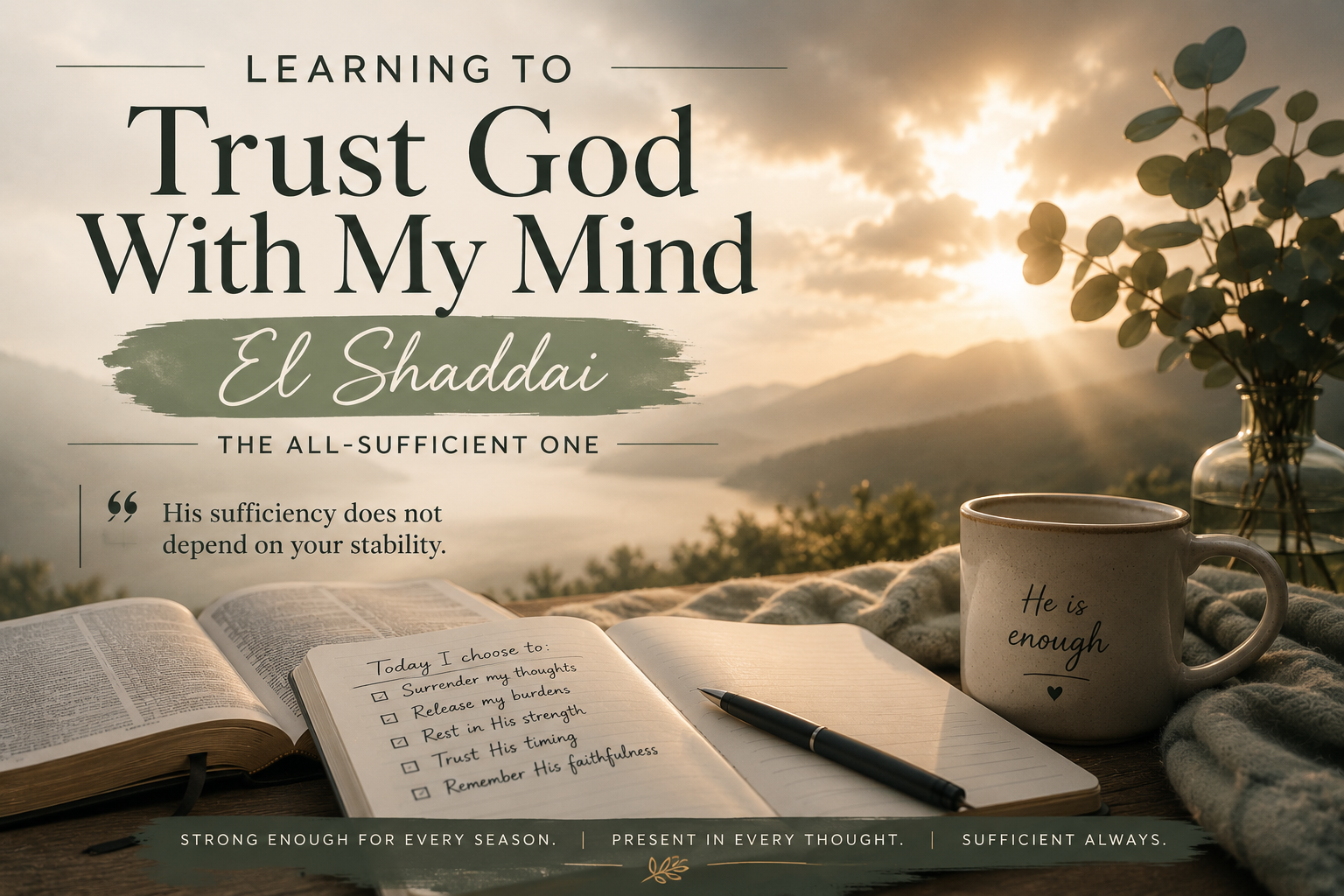
Rooted in the Name: El Shaddai-The All-Sufficient One
For a long time, I thought trusting God meant trusting my mind. Trusting my clarity. My discernment. My ability to correctly interpret what I feel and experience.
But living with Bipolar I complicated that assumption.
There are days when thoughts move too fast to follow, days when everything slows into a fog, and days when certainty itself feels fragile. And in those moments, trust becomes complicated.
How do you trust God when you do not always trust your own mind?
There is a name of God that steadies this tension:
El Shaddai — The All-Sufficient One.
El Shaddai — The All-Sufficient One
“When Abram was ninety-nine years old, the Lord appeared to him and said, ‘I am El-Shaddai—God Almighty. Serve me faithfully and live a blameless life.’” — Genesis 17:1 (NLT)
El Shaddai means God Almighty—the One who is more than enough.
His sufficiency does not depend on your emotional steadiness, mental clarity, or ability to perfectly discern every thought. He remains enough when clarity fades, when perception feels unreliable, and when your mind feels difficult to navigate.
His strength is not dependent on your stability.
Trust Was Never Meant to Depend on Certainty
We often confuse trust with clarity. We assume that if we can fully understand something, then we can finally rest in it. If we can logically explain every feeling, then we can feel secure.
But Scripture never defines trust as intellectual certainty.
“Trust in the Lord with all your heart; do not depend on your own understanding.” — Proverbs 3:5 (NLT)
For those living with Bipolar I or any mental illness, this verse can feel deeply personal.
Understanding fluctuates. Perception can sometimes feel compromised. Certainty can shift from day to day.
But trust was never meant to be confidence in your cognition.
It is reliance on God’s sufficiency.
El Shaddai is strong enough to hold what your mind cannot stabilize.
Surrender is Not the Same as Losing Control
Surrender can feel frightening—especially when control has felt like safety for so long.
When your mind has been unpredictable, control can begin to feel protective. You may find yourself trying to manage every thought, monitor every emotion, double-check every decision, and hold yourself together through sheer effort.
But Scripture reframes surrender.
“Give your burdens to the Lord, and he will take care of you.” — Psalm 55:22 (NLT)
Taking care of you means carrying what you were never meant to carry alone.
You are not required to fix every fluctuation. You are not responsible for stabilizing yourself entirely through vigilance and exhaustion.
El Shaddai does not demand mastery before closeness.
He invites dependence.
Surrender is not giving up.
It is placing your life—and your mind—into steadier hands.
God Does Not Separate the “Stable” Parts of You
It can be tempting to split yourself in two.
To separate the regulated version of yourself from the parts you would rather erase.
That was not really me.
I want to forget that season.
I only want to keep the stable parts.
But Scripture speaks in terms of completion, not erasure.
“And I am certain that God, who began the good work within you, will continue his work until it is finally finished.” — Philippians 1:6 (NLT)
Completion includes the manic highs, the depressive lows, the repair, the healing, and the learning that follows afterward.
God does not abandon messy chapters.
El Shaddai is sufficient for every version of you—not only the steady one.
Trust is not a permanent emotional state.
It is something practiced daily.
“Give us today the food we need.” — Matthew 6:11 (NLT)
Daily provision.
Daily mercy.
Daily surrender.
You do not need lifelong certainty in order to trust God deeply.
You need today’s trust.
El Shaddai’s sufficiency does not disappear when your clarity does. His strength does not weaken when your thoughts feel fragile.
And you are not failing because trust feels repetitive.
Repetition is often how dependence grows.
Reflection
You do not have to trust your mind perfectly in order to trust God deeply.
You do not have to resolve every intrusive thought, decode every emotional shift, or prove your stability in order to receive closeness from Him.
El Shaddai is enough.
Enough for your fragile days.
Enough for your uncertain days.
Enough for your ongoing healing.
Learning to trust God with your mind is not about silencing every thought.
It is about surrendering your mind—gently and repeatedly—to the One who is sufficient.
Journal Prompts
- Where have I equated faith with mental certainty?
- What part of my mind do I struggle most to surrender to God?
- How does El Shaddai’s sufficiency comfort me when I feel unstable?
- Where am I still forcing control instead of practicing dependence?
- What daily practice helps me return to trust?
- What would integration—rather than avoidance—look like in this season?
- If God is truly sufficient, what pressure can I release today?
Leave a Reply